Blog
Under Sink Water Filter: The Complete Guide to Cleaner Tap Water
If you are tired of constantly refilling slow-drip filter pitchers, sacrificing counter space to bulky appliances, or lugging heavy packs of bottled water from the grocery store, an under sink water filter is the most practical upgrade you can make for your kitchen.
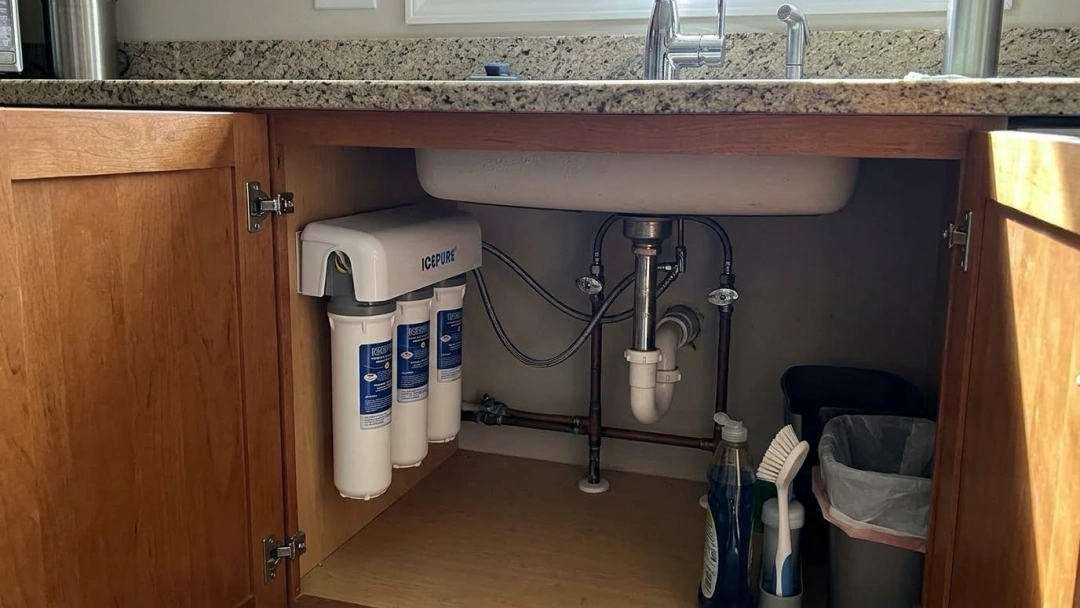
Tucked neatly inside your cabinet, an under-counter filtration system treats cold water right at the point of use—removing chlorine, heavy metals, PFAS (“forever chemicals”), and microscopic sediment before the water ever reaches your glass. Below is everything you need to know about how under sink water filters work, the three main system configurations, and how to choose the right model for your home’s water profile.
Why Choose an Under Sink Water Filter Over Pitchers or Faucet Mounts?
While pitcher filters and faucet-mounted attachments are inexpensive entry points, they come with major trade-offs in flow rate, capacity, and filtration depth. Moving your filtration beneath the sink solves these everyday frustrations:
- Zero Countertop Clutter: Everything—from the filter cartridges to the manifold—stays hidden inside your sink base cabinet, leaving your kitchen counters clean.
- High Flow Rate on Demand: Instead of waiting five minutes for a pitcher reservoir to trickle through carbon granules, under sink systems use your home’s existing water line pressure to deliver 75 to 2.0+ gallons per minute (GPM) instantly.
- Superior Contaminant Removal: Because under-counter cartridges are larger and allow for longer contact time (often down to 5 microns or finer), they capture lead, cysts, volatile organic compounds (VOCs), and forever chemicals that basic pitcher filters miss.
- Lower Cost Per Gallon: Standard under sink replacement filters last between 6 and 12 months (filtering 1,000 to 5,000+ gallons), slashing your annual cost per gallon compared to replacing tiny pitcher filters every 40 gallons.
3 Main Types of Under Sink Water Filters Compared
Before buying a system, you need to decide whether you want to filter all the cold water coming out of your existing kitchen faucet or install a dedicated drinking water faucet next to your main tap.
|
System Type |
Faucet Setup |
What It Removes |
Water Pressure Impact |
Average Price |
|
Direct-Connect (In-Line) |
Uses your existing kitchen faucet |
Chlorine, taste, odor, lead, rust, cysts (0.5–5 microns) |
Minimal (maintains high flow) |
$60 – $160 |
|
Multi-Stage Ultrafiltration (UF) |
Dedicated beverage faucet (or direct) |
Sediment, heavy metals, PFAS, bacteria (down to 0.01–0.5 microns) |
Moderate |
$100 – $250 |
|
Reverse Osmosis (RO) |
Dedicated RO faucet + drain line |
Up to 99% of TDS, fluoride, arsenic, nitrates, heavy metals, salts |
Lower (unless tankless with booster pump) |
$180 – $550+ |
Direct-Connect (Single-Stage) Under Sink Filters
Also known as in-line filters, these compact systems splice directly into your 3/8-inch cold water supply line. Every time you turn on the cold side of your main kitchen faucet—whether to fill a pasta pot, wash vegetables, or grab a drink—the water is filtered.
Best For: Renters and homeowners on municipal tap water who want fast installation (under 15 minutes) without drilling a hole in their granite or quartz countertop.
Multi-Stage Carbon & Ultrafiltration (UF) Systems
These units link two or three canisters together beneath the sink: typically a 5-micron sediment pre-filter, a catalytic carbon block for chloramines and chemicals, and a 0.5-micron or 0.01-micron hollow-fiber membrane.
Best For: Households that want advanced protection against lead, microplastics, and cysts while retaining healthy natural minerals like calcium and magnesium—and generating zero wastewater.
Under Sink Reverse Osmosis (RO) Systems
If your local tap water has high Total Dissolved Solids (TDS), fluoride, hexavalent chromium, or heavy metals, an under sink RO system forces water through a semi-permeable 0.0001-micron membrane.
Traditional Tank vs. Tankless RO: Older RO systems require a bulky storage tank under the sink. Modern tankless under sink RO systems use an internal electric booster pump to filter water on demand, saving up to 70% of cabinet space and improving efficiency to a 2:1 or 3:1 pure-to-drain water ratio.
5 Key Features to Check Before Buying
Not all cartridges inside a sleek plastic housing perform equally. Evaluate these five specifications before making your decision:
Official NSF/ANSI Certifications
Never rely on vague marketing claims like “removes 99% of contaminants.” Look for independent certification seals from NSF International, WQA, or IAPMO:
- NSF/ANSI Standard 42:Reduces aesthetic impurities like chlorine, taste, Odor, and coarse particulates.
- NSF/ANSI Standard 53:Certified to reduce health-related contaminants including lead, mercury, PFAS, VOCs, and protozoan cysts.
- NSF/ANSI Standard 58:The gold standard specifically for Reverse Osmosis TDS reduction.
- NSF/ANSI Standard 401:Targets emerging contaminants like trace pharmaceuticals, herbicides, and microplastics.
Micron Rating (Pore Size)
A filter’s micron rating dictates the smallest physical particle it can trap. For an under sink drinking water filter, aim for a 0.5-micron to 1-micron carbon block (or sub-micron UF/RO membrane) to ensure microscopic cysts and fine pipe silt are completely blocked.
Twist-and-Lock Filter Replacements
Old-school under sink housings required a plastic wrench, a bucket, and shutting off the main water valve just to swap a wet, messy cartridge. Modern systems feature quarter-turn twist-and-lock cartridges with internal auto-shutoff valves—allowing you to twist out the old filter and click in a fresh one in 3 seconds without spilling a drop.
Flow Rate (GPM)
If you choose a direct-connect system that feeds your main kitchen faucet, ensure the system is rated for at least 1.5 to 2.0 GPM (gallons per minute) so washing dishes doesn’t feel sluggish. Dedicated drinking faucets typically run comfortably at 0.5 to 0.8 GPM.
Frequently Asked Questions (FAQ)
Do under sink water filters reduce water pressure?
Direct-connect under sink filters are engineered with high-flow ports and typically cause no noticeable drop in everyday faucet pressure. However, when a filter cartridge reaches the end of its 6-to-12-month lifespan and becomes packed with trapped sediment, water pressure will noticeably slow down—signaling that it is time for a replacement cartridge.
Can I install an under sink water filter in a rental apartment?
Yes! A direct-connect (in-line) under sink filter is 100% renter-friendly because it connects straight to the existing cold water supply line without drilling holes into the countertop. When your lease ends, you simply unscrew the adapter, reattach the original faucet hose, and take the filtration system with you.
Does a carbon under sink filter remove healthy minerals from water?
No. Activated carbon block and ultrafiltration (UF) under sink systems selectively trap chemical contaminants, chlorine, lead, and sediment while allowing beneficial dissolved minerals like calcium, magnesium, and potassium to pass right through. Only Reverse Osmosis (RO) membranes strip out dissolved minerals (though many RO systems offer an optional alkaline remineralization stage).
How much does an under sink water filter cost per year to maintain?
Depending on whether you own a single-stage carbon filter or a multi-stage RO system, replacement cartridges typically cost between $40 and $110 per year—roughly $0.10 to $0.30 per day for unlimited filtered drinking and cooking water.
Upgrade Your Kitchen Hydration Today
An under sink water filter strikes the ideal balance between whole-house filtration power and everyday kitchen convenience. Whether you choose a 15-minute direct-connect carbon system to upgrade your main tap or a tankless Reverse Osmosis system for total purification, you will enjoy crisp, chemical-free water right from your sink while eliminating single-use plastic bottles for good.
Ready for cleaner, better-tasting tap water?
Explore our NSF-Certified Under Sink Water Filter Systems & Replacement Cartridges here!